About
Firmware, emulators and tools for the Oric, the Neo6502 and the Minitel.
The collective · Our charter · Contribute · Press · Contact
The collective
Tachibana is a collective devoted to three machines: the Oric, an 8-bit home computer from the 1980s, the Olimex Neo6502, a current board built around a 65C02 processor, and the Minitel. For the Neo6502, it develops Trinity, an alternative firmware built on Paul Robson's official firmware: NeoDOS, a USB modem, new video modes and a complete API reference, with examples checked in C, Mad Pascal, NeoBASIC and assembly. For the Oric, it develops the Phosphoric emulator, which also runs in the browser, and games such as Astéroric. On the telematics side, 3617 TACHIBANA is a live Minitel service, and Wi-Fi modems connect these machines to the network.
The collective keeps, creates and passes on: it documents its work, publishes most of its software with the source code, and welcomes testers and contributors.
Tachibana is an independent collective. It is neither affiliated with nor endorsed by Olimex. Neo6502 is an Olimex product; Oric is a trademark of its respective owners.
Our charter
Each project has a single name and one of these four states:
| State | Meaning |
|---|---|
| Planned | Defined idea, nothing to install |
| In development | Usable for testing, may change |
| Available | Published, installable version: version number and date |
| Archived | No longer maintained, kept for the record |
We write short sentences, with no superlatives and no promises: no release dates, no “coming soon”. Every figure, version or feature comes from a repository. We do not judge other people's work: the Neo6502 and its official firmware are the work of Olimex and Paul Robson, and Trinity builds on their work.
Most of our repositories are under the EUPL 1.2 licence. Two derive from an existing project and keep its licence: Trinity (MIT, like the official firmware) and the Oric Wi-Fi modem (GPL-3.0, like sodiumlb's project). Some repositories are still private: their page says so.
Contribute
Published programs have their code on GitHub or Codeberg. To report a problem, open an issue on the program's repository; each product page gives its repository.
Testers are welcome, on a real board as on an emulator: a precise report (version, hardware, steps) is worth a fix. To offer a larger contribution, write to us first.
Press
Reference texts, to be used as they are:
One line — Firmware, emulators and tools for the Oric, the Neo6502 and the Minitel.
One paragraph — Tachibana is a collective that keeps 8-bit home computers alive. It develops Trinity, an alternative firmware for the Neo6502, the Phosphoric (Oric) and Phosphoneo (Neo6502) emulators, Wi-Fi modems and a Minitel service, 3617 TACHIBANA. The Neo6502 software is tested on the board, and most programs are published with their source code.
Logo and crest, in SVG and PNG:




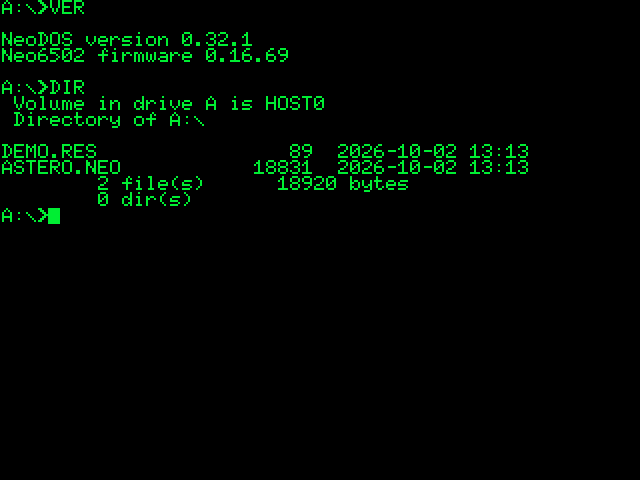
Screenshot, free of rights (approved on 2 October 2026):
For any request (interview, visuals, details): contact@tachibana.eu.
Contact
E-mail: contact@tachibana.eu.
Minitel: 3617 TACHIBANA, on the PAVI 3617.
Code: github.com/benedictemarty and codeberg.org/benedicte.